






Aragonite: calcite's restless twin
It has the same chemistry as calcite, builds pearls and coral, and slowly turns into calcite over geological time.
Aragonite and calcite are both calcium carbonate. The difference is how the atoms are stacked. Calcite is the stable form at the Earth's surface. Aragonite forms where conditions push the other way, in warm springs, in caves, in high-pressure rocks and inside living things. Left alone for long enough, it slowly turns back into calcite.
Living things love it. The shiny inner layer of many shells, the nacre that makes a pearl glow, and the skeletons of most reef corals are aragonite. The mineral is named after the region of Aragon in Spain, where it was first described, and Spanish aragonite grows as neat six-sided twins.
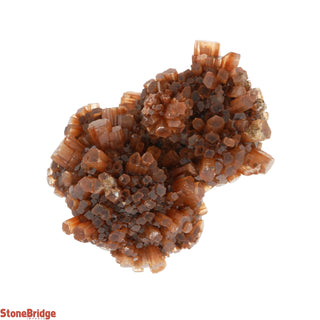
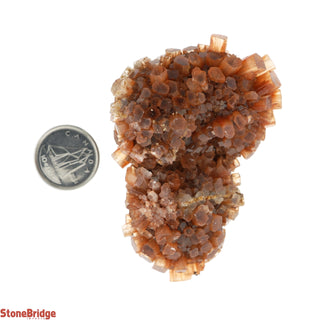
The pieces most shops know are sputniks. These are clusters of brown or orange crystals that grow out from a centre in every direction, like a small starburst or an old satellite. Each one is different, and the points are fragile.
Banded aragonite is a different look. It grows in layers, much like an onyx, in shades of honey, brown and cream, and polishes into spheres and dishes. Because aragonite is soft (3.5 to 4 on the Mohs scale), polished pieces need gentler handling than quartz.
Pearls, coral and seashells are built from it. So is every sputnik on the shelf.


