


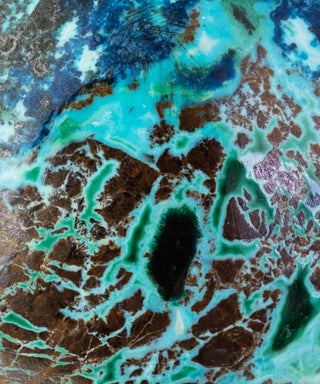
Chrysocolle
Plus d'infos
La chrysocolle a une belle couleur bleu-vert et est un minerai de cuivre mineur. Elle se présente généralement sous forme de croûtes poreuses impropres à l'utilisation en tant que gemme. La chrysocolle de qualité supérieure, de qualité gemme, peut être translucide et est très prisée.
Origine
République du Congo
Histoire
Le nom vient du grec chrysos qui signifie « or » et kolla qui signifie « colle », en allusion au nom du matériau utilisé pour souder l'or. Il a été utilisé pour la première fois par Théophraste en 315 av. J.-C.
Propriétés métaphysiques
Pierre de sérénité, la chrysocolle vous aide à surmonter la peur, l'anxiété et la culpabilité. C'est une belle pierre pour la maison qui fait ressortir la négativité et encourage la paix dans les relations. La chrysocolle calme, nettoie et redynamise les chakras.


Vous regardez 1-2 de 2 produits
Buying chrysocolla for a shop
Chrysocolla is a blue to blue-green copper silicate. It forms where copper deposits weather, and it often grows together with quartz, chalcedony, malachite and other copper minerals, so many pieces show green, brown or black patches beside the blue. Pure chrysocolla is soft, about 2 to 4 on the Mohs scale, and porous. Pieces with quartz or chalcedony running through them are harder and take a better polish.
Read more
What is in this collection
- Chrysocolla Light A tumbled stones from Peru, a paler blue-green grade, sorted into X-Small, Small, Medium and Large.
- Dainty 2-3mm chrysocolla bead necklaces.
Selling chrysocolla
Because chrysocolla is soft and porous, much of the chrysocolla jewellery on the market is stabilized with resin, mixed with other stone, or imitated with dyed stone. Pass on simple care: keep it out of water and away from cleaners, and store it apart from harder stones. Tumbled chrysocolla sells well in mixed blue and green bowls, and it is traditionally associated with calm communication.
See also Tumbled Stones, Malachite, Necklaces and 2-3mm Bracelets.
Chrysocolle FAQ
What is chrysocolla?
Chrysocolla is a blue to blue-green copper silicate mineral. It is often found mixed with quartz, chalcedony or malachite, which adds green, brown or black patches.
Is chrysocolla hard enough for jewellery?
Pure chrysocolla is soft, about 2 to 4 on the Mohs scale, so it suits necklaces and pendants better than rings. Pieces mixed with quartz are harder.
Is chrysocolla ever dyed or stabilized?
Yes. On the market, chrysocolla is often stabilized with resin, mixed with other stone, or imitated with dyed stone. Ask us about any product before you label it.
Is there a minimum order?
No. There is no minimum order, and approved wholesale customers see wholesale prices when signed in.